
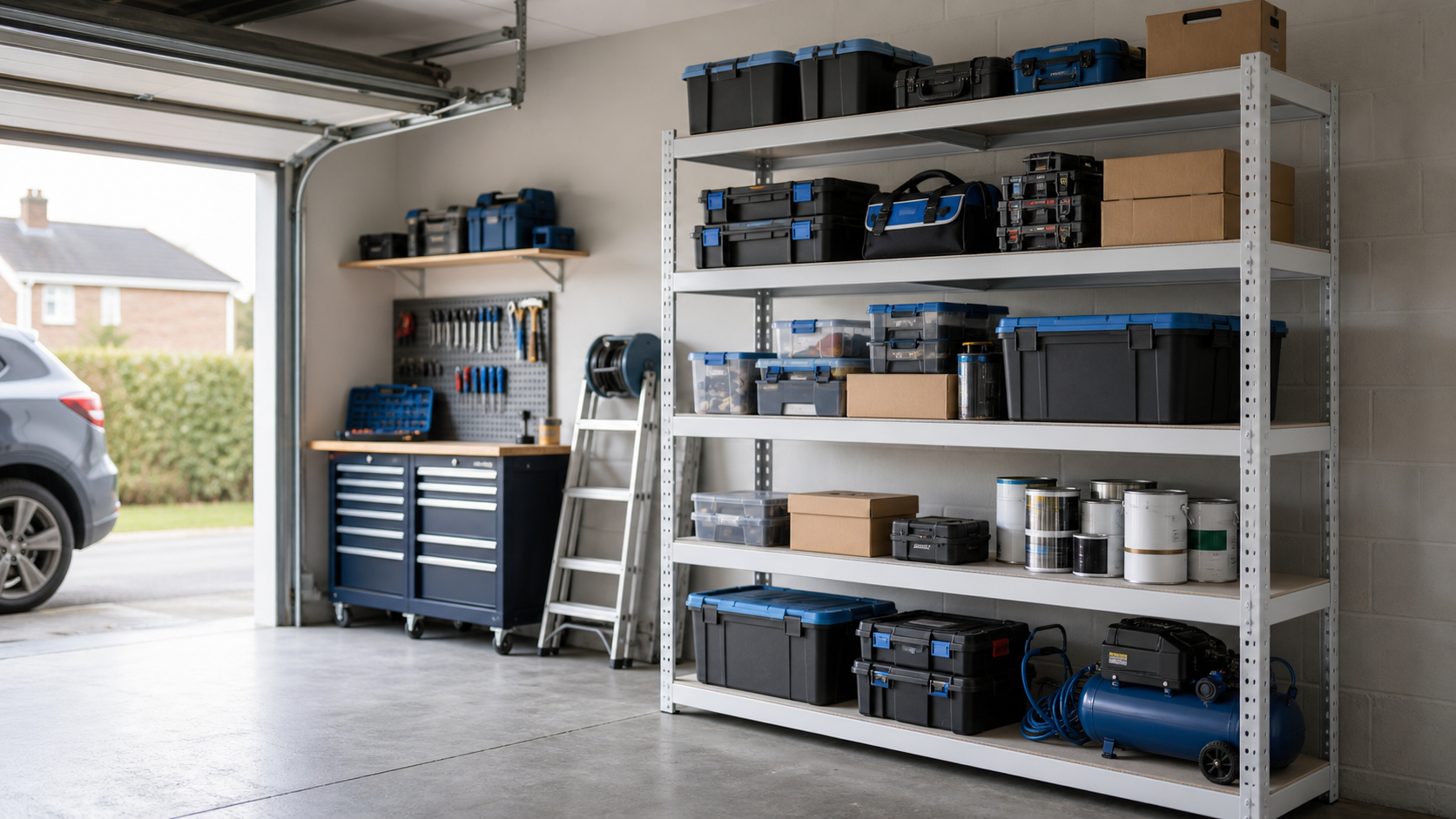
Heavy duty garage shelving is a hand-loaded storage system designed for tools, boxes, parts and equipment that would overload lightweight domestic shelving. Before buying, check the available width and depth, the load rating per tier, floor condition, assembly method and how often stored items need to be reached.
Most UK garages are smaller than people expect. A standard single garage measures around 5.4m long by 2.6m wide — barely enough for one car and a set of shelves along the wall. When the floor starts disappearing under tools, boxes and seasonal gear, the instinct is to search for heavy duty garage shelving UK and order the biggest rack available.
That approach usually leads to shelving that does not quite fit, cannot handle the weight it needs to carry, or becomes frustrating to use within a few weeks. This buyer checklist is designed to help UK homeowners, tradespeople and small business owners avoid those problems by asking the right questions before placing an order.
Work through each point before buying. Ten minutes of planning now prevents an awkward return or a wasted installation later.
Quick Buyer Checklist
Before searching for garage shelving in the UK, confirm the following:
- Have you measured available wall width and ceiling height?
- Do you know the total weight of what you plan to store per shelf?
- Have you checked whether the floor is level where the shelving will stand?
- Have you decided which items need daily access versus occasional access?
- Have you checked whether the garage wall is brick, block or plasterboard?
- Have you confirmed whether you need adjustable shelves or fixed heights?
- Have you compared load ratings, not just overall unit size?
If you answered no to any of the above, the sections below cover each point in detail.
1. Measure the Garage Before You Search
UK garages vary significantly in size. A standard single garage is typically around 5.4m x 2.6m, but older terraced or semi-detached homes in areas like Greater Manchester often have narrower garages closer to 2.3m–2.4m wide. A double garage usually runs to around 5.4m x 5.0m, though dimensions vary widely depending on the property era.
Before looking at any shelving options, take three measurements:
- Available wall width: Measure the wall where shelving will go. Account for doors, windows, sockets and any pipework that cannot be blocked.
- Ceiling height: Standard UK garage ceiling height is around 2.1m–2.4m. Know the height before buying tall shelving units.
- Walkway clearance: Leave at least 900mm clear for comfortable movement. If a car also parks in the space, allow an additional 600mm–800mm for the car door to open.
A common mistake is buying shelving that is theoretically the right height but physically cannot stand upright because a sloped ceiling or lintel blocks it. Measure the usable height at the exact position the shelving will go, not just the highest point of the room.
For specific layout recommendations in the Manchester area, the garage shelving Manchester page covers common space types and local delivery options.
2. Match the Load Rating to What You Actually Store
The load rating — often shown as UDL, or uniformly distributed load — tells you the maximum weight per shelf when that weight is spread evenly across the surface. A shelf rated to 200kg UDL can handle 200kg across the whole shelf, not concentrated in one spot.
UK garage storage tends to be heavier than people estimate. Here are some common items and approximate weights to factor into your planning:
| Stored Item | Approximate Weight |
|---|---|
| Heavy toolbox (full) | 30–60kg |
| 4 x 5-litre paint tins | 20–30kg |
| Car jack and axle stands | 25–40kg |
| Set of seasonal tyres | 40–60kg |
| Boxes of archive files | 20–30kg per box |
| Power tools and battery packs | 15–40kg |
| Pressure washer | 15–25kg |
Add up what you plan to put on each shelf. A shelf carrying seasonal tyres plus a heavy toolbox could easily reach 100kg. If that shelf is rated to only 80kg, it will bow — or fail — under load.
For heavier storage needs, the 800kg heavy duty shelving unit is the recommended choice for tools, car parts, trade stock and dense workshop equipment.
3. Think About Access, Not Just Storage Volume
A garage can look tidy for one week and become completely frustrating within a month if the layout ignores how items are actually used. Plan shelf heights around access frequency, not just available space.
A practical approach is to divide shelving into three zones:
- Daily access zone (waist to shoulder height — roughly 700mm to 1,500mm from the floor): Tools you reach for regularly, items in active use, anything you handle more than once a week.
- Weekly access zone (floor level to waist, and shoulder height to around 1,800mm): Power tools used occasionally, spare parts, cleaning supplies, boxes you open weekly.
- Seasonal or archive zone (above 1,800mm): Christmas decorations, camping equipment, items used once or twice a year.
This zoning approach means the items you use most are always at the easiest height to reach. It also keeps the heaviest items on the lower shelves, which is safer for the shelving unit and reduces back strain when lifting.
4. Choose a Shelving Style That Suits a UK Garage
Not all heavy duty shelving performs equally in a UK garage environment. Garages in the UK are typically unheated, subject to temperature variation across seasons, and can suffer from condensation — particularly in older properties. The shelving style and material should reflect this.
| Type | Pros | Cons | Best For |
|---|---|---|---|
| Boltless steel shelving | Fast assembly, adjustable, strong | Can rust without powder coating | General garage, workshop |
| Bolt-together steel | Very robust when fully assembled | Complex to adjust | Permanent workshop setups |
| Wire mesh shelving | Good airflow, rust-resistant options | Less suited to small items without liners | Damp areas, trade storage |
| Chipboard-decked steel | Flat surface, practical for mixed use | Chipboard can swell if exposed to moisture | Dry garages, indoor workshops |
For most UK garages, powder-coated boltless steel shelving with chipboard decks is the most practical option. The powder coating resists moisture, the boltless design makes it easy to adjust shelf heights as storage needs change, and the chipboard surface provides a stable, flat platform for tools and boxes.
If the garage suffers from condensation or is partially open, a wire mesh deck or galvanised frame is a better long-term choice.
5. Check Stability and Wall Fixings
Even a well-assembled shelving unit needs a stable base. Garage floors are not always perfectly level — expansion joints, drainage slopes and uneven concrete are common in UK garages, especially in older properties.
Before assembly:
- Use a spirit level to check the floor where shelving will stand.
- If the floor is uneven, adjustable feet (included with many heavy duty units) can compensate for up to 20–30mm of variation.
- On very uneven floors, a thin plywood base can provide a level platform.
For taller shelving units — anything above 1,800mm — wall fixing is strongly recommended. In UK garages, walls are typically solid brick or block, which provides a solid anchor. Fix using appropriate masonry anchors rather than standard plasterboard fixings. If the wall is dry-lined, fix into the masonry behind the plasterboard, not into the board itself.
A wall-fixed unit is significantly more stable than a freestanding unit, particularly in a working garage where shelving might be bumped by equipment or vehicles.
6. Plan for Future Storage, Not Just Today’s Boxes
Most buyers purchase garage shelving based on current needs and underestimate how quickly those needs grow. A garage that feels spacious with three shelves today often fills up within 12 to 18 months, particularly once the shelving makes the rest of the space easier to use.
Choose a shelving system that can expand:
- Modular bays: Some heavy duty shelving systems allow additional bays to be added using the existing uprights, reducing the cost of expansion.
- Adjustable shelf heights: Look for uprights with multiple shelf pin positions so that as stored items change in size, the shelf heights can adapt.
- Matching accessories: Wire mesh decks, extra shelves and divider panels can be added later without replacing the whole unit.
Buying a slightly larger or more capable unit at the start is almost always cheaper than replacing an undersized unit two years later.
7. Compare Price Against Strength and Lifespan
Garage shelving ranges from under £50 for lightweight domestic units to several hundred pounds for heavy duty industrial-grade racks. The price difference reflects load capacity, frame gauge (the thickness of the steel), shelf material quality and the overall strength of the locking system.
A low-cost unit rated to 60–80kg per shelf may be adequate for light seasonal storage. For tools, car parts, trade stock or anything that will be loaded and unloaded regularly over several years, the cost per year of a stronger unit is almost always lower — even if the upfront price is higher.
- Load rating per shelf (not just the unit total)
- Frame gauge or steel thickness — heavier gauge means a stronger frame
- Whether shelves are adjustable or fixed
- Whether the unit can be extended with additional bays
Common Mistakes UK Buyers Make When Choosing Garage Shelving
Buying shelving that is too shallow: Standard depths of 300mm or 400mm are often too shallow for large toolboxes, car parts or bulky storage boxes. A depth of 500mm or 600mm provides significantly more practical storage.
Ignoring the garage environment: Uncoated steel in a damp UK garage will begin to surface rust within a few years. Choose powder-coated frames and check that shelf decks are sealed or treated.
Overloading the top shelf: The most accessible shelf tends to become the most overloaded. Keep the heaviest items on lower shelves to maintain stability and reduce the risk of items falling.
Not fixing tall units to the wall: Freestanding shelving above 1.8m is a tipping risk in a working garage where the unit might be knocked. A simple masonry fixing takes under 20 minutes and significantly improves safety.
Choosing the wrong shelf spacing: Buying a unit with fixed positions that do not match actual storage heights means wasting space above shorter items or being unable to fit taller equipment. Adjustable shelving solves this from the start.
Recommended Heavy Duty Garage Shelving
For buyers who need reliable garage storage that handles tools, car parts and heavy boxes, the Heavy Duty Metal Shelving – 800kg Capacity is the recommended starting point. It is designed for demanding use, adjustable to different shelf heights and suited to UK garage environments when powder-coated.
For buyers in Greater Manchester and the surrounding area, local delivery and shelving layout support is available via the Manchester shelving page. If you have a specific garage layout or weight requirement and want a recommendation before ordering, contact the team directly via WhatsApp for a quick response.
Ready to compare a heavy duty shelving unit?
RackingOutlet’s four-tier boltless unit is rated at 200kg UDL per tier, giving 800kg total capacity across the complete unit. Check the dimensions, price and current ordering details before deciding whether it fits your garage or workshop.
FAQ
What width of shelving fits a standard UK single garage?
A standard UK single garage is typically 2.3m–2.6m wide. A shelving bay of 900mm–1,000mm width is the most practical choice because it leaves room for a walkway and, in many garages, space for a car alongside. Avoid wide bays if the garage is narrower than 2.4m without measuring first.
Can heavy duty garage shelving handle car parts and automotive tools?
Yes, provided the shelf load rating matches the weight of the items. Car parts vary widely — a set of steel wheels with tyres can weigh 60–80kg. Choose shelving rated to at least 200kg per shelf for heavy automotive storage, and always keep the heaviest items on the lowest shelf.
Is it better to wall-fix garage shelving in the UK?
For any unit above 1.8m in height, wall fixing is strongly recommended. UK garages typically have solid brick or block walls that provide a strong anchor for masonry fixings. Wall fixing prevents tipping and adds long-term stability, particularly in a working garage where the unit may be knocked or heavily loaded.
How much does heavy duty garage shelving cost in the UK?
Heavy duty garage shelving in the UK typically ranges from £80 to £300+ per bay, depending on capacity, materials and shelf size. Units rated to 200kg–800kg per shelf sit in the £150–£300 range for most standard bays. Budget units rated under 100kg per shelf are available for less but are not suited to heavy garage storage.
Can garage shelving cope with a damp or cold UK garage?
Standard chipboard-decked shelving can degrade in persistently damp conditions. For garages with condensation problems, choose powder-coated steel frames with wire mesh or steel shelf decks. These materials handle moisture, temperature variation and regular cleaning better than board-based decks over the long term.
What is the difference between garage racking and garage shelving?
Garage shelving is hand-loaded and designed for general storage of boxes, tools and equipment. Racking refers to heavier-duty systems designed for pallet storage or forklift access. For a domestic or trade garage, shelving is the correct choice. Pallet racking is usually oversized and takes up significantly more floor space.
How many shelves does a standard heavy duty shelving unit have?
Most heavy duty shelving units come with 4–5 shelves as standard, with additional shelves available as accessories. Starting with 4 or 5 adjustable shelves gives enough flexibility for mixed-height storage and allows further additions as needs grow.